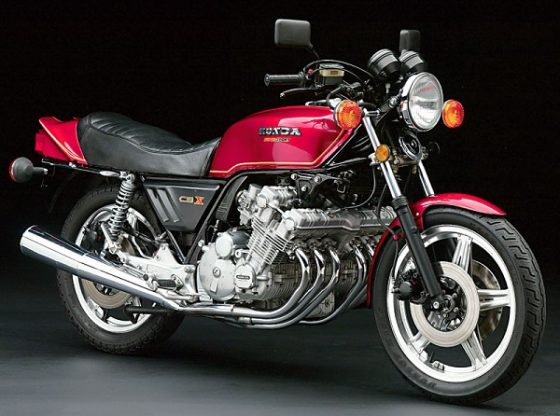

Adorning the front cover of virtually all the motorcycle press in 1977 was a unfamiliar picture. Six header pipes all in a row backed by a twin cam block, and half a dozen carbs.
Few could fail to appreciate the iconic metal sculpture that was released on the world as the Honda CBX. The X heralded not just a ten for the full litre but almost a seminal moment when Honda stole the show once more.
As many people are aware, Japan wasn’t the first country to produce a road bike with six pots in a row, that accolade belonged to the mouse that roared; the Binelli Sei 750.
But Honda was probably a little irked after having their Japanese big bike crown stolen from their CB750 by the mighty Z1 from Kawasaki, a bike that, despite handling like a bag of the proverbial, took centre stage with its unburstable twin cam 900cc mill and swoopy good looks.
But Honda wanted it back, so they raised an extra hundred and a couple of barrels for good measure.
Whether it was pioneering engineering, a clever marketing ploy or just a happy accident, the boys from Tokyo decided that a large block of finned alloy could quite easily be utilised as a stressed part of the bike’s frame, eliminating the need for unsightly cradle down tubes, allowing the cathedral of chrome headers to shine forth like no other.

This new class of Superbike wasn’t just all show either; its beautiful proportions were backed up by a full set of ponies, a hundred and three to be precise, which made its 11.36s standing quarter the fastest in the world.
Its technological leap of four valves per 64mm bore with the luxury of a big bore carb for each one, was a recipe for success.
Despite its size, the bike was a reasonably good handler in its day. The engine was pared down in width by putting all the gubbins normally hanging on the crankshaft, like the alternator and ignition, behind the engine block, which allowed generous amounts of leaning.
The afore mentioned frame was robust and Honda worked hard on the design to make their baby fast and safe in the corners.
News spread like a rash, and with the added benefit of some nice, clean colour combinations, ample rider comfort and sophisticated instruments and switchgear Honda found itself with an international standing ovation.

But the cheering was short lived. Despite its clean lines the bike was a bit of a dead weight around town. Granted, that motor could haul ass when needed, but at over a quarter of a tonne, that was one heavy old lady to go dancing with in the village, especially on those slender front forks.
The late 70s was also a time of creeping fuel prices and the six thirsty carbs couldn’t be excused for their disrespectful binge drinking and keeping them nicely balanced was a tricky job for the most patient Swiss watch-maker.
Being chain driven, regular withdrawals from the owner’s bank account for fresh links, sprockets and the comparatively skinny tyres was a little too regular.
While Honda bathed in its glory a whole host of other manufacturers started sneaking back stage to take a slice of the super bike pie with bigger, faster and sometimes tougher looking machinery than the pretty CBX.
Honda can often get accused of being a bit ‘sensible’, and that’s where they probably got it wrong. Worried that the newly-introduced German 100bhp maximum bike speed limit would be enforced around the whole of Europe the factory detuned the original mill to 98bhp.
Then Honda, rather strangely, adorned the bike with much plastic including a large fairing, panniers and various other bits of touring garb and added the title ‘Sports Tourer’ to their adverts.

By loading up so much extra weight the bike ate its own performance, painting itself into a corner. Not even the very advanced Pro-link suspension could save it from lack of interest, especially when being hidden by the afore-mentioned panniers. The bike became a bit of an oddity in its ‘New Romantic’ clothes.
Soon, along came Katanas and Z1300s to steal Honda’s crown again and the big six was soon to be overshadowed by a dozen other machines.
Barely 5 years after its launch, production ceased. Maybe if the style makeover had erred towards a pure sports bike, the Honda could surely have squeezed much more power out and pushed a few more Yen in the bank. We will never know.
A few die-hards bolted tweaked engines into specialist frames such as the magnificent French Moto-Martin just to prove that point, but for the standard bike it was ‘exit stage left’ far too soon.

Looking back its possible to think of the CBX as probably launched before all the homework was done. It was clean, attractive and benefited from a great deal of forward thinking, plus it held its own in a fierce market at the time, but it was trapped between two styles and became a victim of a changing world.
Maybe if the company had continued its boundary-pushing attitude with the later model and subjected it to a strict weight loss program, we could have enjoyed five years more.
Still, with our rose-tinted glasses looking at an idealistic world, perhaps we should just remember those first magazine shots and come to terms with the fact that Honda’s first CBX 1000 wasn’t meant to be just a motorbike, it was designed to be an icon – and it achieved that very well.
CW